
Sudoku Solver
Enter a sudoku and solve it step by step with technique explanations.
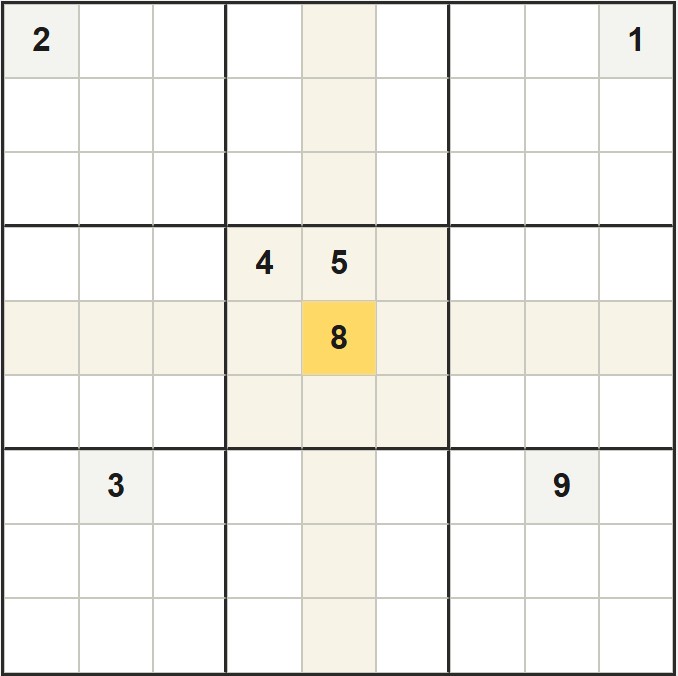
Tap a cell and type a digit to enter the puzzle. Click "Next step" for an explanation per move (Naked Single, Hidden Single, Naked Pair and more), or "Solve fully" to solve it all at once. Works for 4×4, 6×6 and 9×9 sudoku — ideal for learning solving techniques or checking a tricky puzzle.
Sudoku solving techniques
This solver uses logical techniques in increasing order of difficulty. Each step in the solution shows which technique was applied:
- Naked Single
- A cell has only one possible candidate left — all other digits are already in its row, column or block. Place that digit.
- Hidden Single
- Within a row, column or block, a digit can only fit in one specific cell — even if that cell still has multiple candidates from a "naked" perspective.
- Naked Pair
- Two cells in the same unit have the same two candidates. Those two digits can be removed as candidates from all other cells in that unit.
- Pointing Pair
- Within a block, a digit appears only in cells on one row or one column. That digit can be removed from the rest of that row or column outside the block.
- Hidden Pair
- Two digits appear as candidates only in the same two cells of a unit. All other candidates in those two cells can be eliminated.
- X-Wing
- A digit has exactly two candidate positions in two different rows, and those positions share the same two columns. The digit can be eliminated from those columns in other rows.
Frequently asked questions
How do I enter a sudoku to solve?
First select the grid size (4×4, 6×6 or 9×9) at the top. Click a cell and enter the given digit using the numpad or your keyboard. Repeat for all known digits. Then click "Next step" to see the next logical move, or "Solve fully" to work out the entire puzzle. You can also paste a digit string (row by row, with dots or zeros for empty cells).
Can the solver solve every sudoku?
Yes, as long as the input is a valid sudoku with exactly one solution. The solver uses logical techniques (Naked Single, Hidden Single, Naked Pair, Hidden Pair, Pointing Pair and X-Wing) and handles all puzzles up to expert level without guessing. For very exotic puzzles requiring deeper techniques (XY-Wing, Swordfish, chains), our solver usually still works — but exceptions exist.
What does the solver do if the sudoku has no solution?
If the input is impossible — for example a digit appearing twice in a row, column or block, or an empty cell with no possible candidate — the solver shows an error message pointing to where the conflict is. Check your input first: typos in the given digits are by far the most common cause. Erase wrong digits, add missing ones, and try again.
What if my sudoku has multiple solutions?
A real sudoku by definition has exactly one valid solution — that is a core requirement of the puzzle type. If your puzzle has multiple solutions, given digits are missing (the puzzle is incomplete). The solver detects this and signals that the puzzle is ambiguous. If possible, add extra given digits to make the solution unique, or accept that this is not a valid sudoku.
Does the solver show the solution step by step?
Yes — that is the main difference with other online solvers. Click "Next step" and the solver places exactly one digit, with a short explanation of which technique was applied (e.g. "Hidden Single in block 5: 7 can only go in cell R5C5"). You see not just the answer, but why each step works — useful for improving your own solving skills.
What is the difference between a Naked Single and a Hidden Single?
Both lead to one placed digit, but the perspective differs. Naked Single: look at the cell — only one digit is still possible because all others already appear elsewhere in its row, column or block. Hidden Single: look at the unit (row, column or block) — a digit can only go in one cell within that unit, even if that cell still has multiple candidates of its own. Naked Single is the simplest technique; Hidden Single requires more searching and is often missed by beginners.
Which difficulty levels can the solver handle?
All four levels from our generator: easy, medium, hard and expert. For easy and medium, Naked and Hidden Singles are usually enough. Hard puzzles also require Pairs and Pointing Pairs. Expert puzzles typically need X-Wing and sometimes deeper techniques. The solver automatically applies the simplest technique that works at each step, so you can follow the solving path most clearly.
How can I tell how difficult my entered sudoku is?
The solver automatically applies the simplest working technique at each step. The deepest technique required to solve the puzzle is a good indicator of difficulty: only Naked and Hidden Singles = easy; with Pairs added = medium; Pointing Pairs and Hidden Pairs = hard; X-Wing or deeper = expert. Walk through the step-by-step explanation to see which techniques were used on your puzzle.
Can I enter a puzzle from a newspaper or book?
Yes — click an empty cell and type the given digit. Work row by row. If you have a digit-only sudoku (an 81-character string for 9×9), you can also paste it into the input field. Be careful: a single typo makes the puzzle unsolvable. Double-check your input before clicking "Solve fully".
Does the solver also work for 4×4 and 6×6 sudoku?
Yes, all three sizes are fully supported. 4×4 uses 2×2 blocks with digits 1-4 (ideal for children or for learning techniques). 6×6 uses 2×3 blocks with digits 1-6. 9×9 is the classic variant with 3×3 blocks and digits 1-9. Select the desired size at the top before you start entering — the solving techniques work identically across all three.
Is the sudoku solver free?
Yes, the solver is completely free, no account is needed, and there is no limit on the number of puzzles you can solve. It works on desktop, tablet and phone.